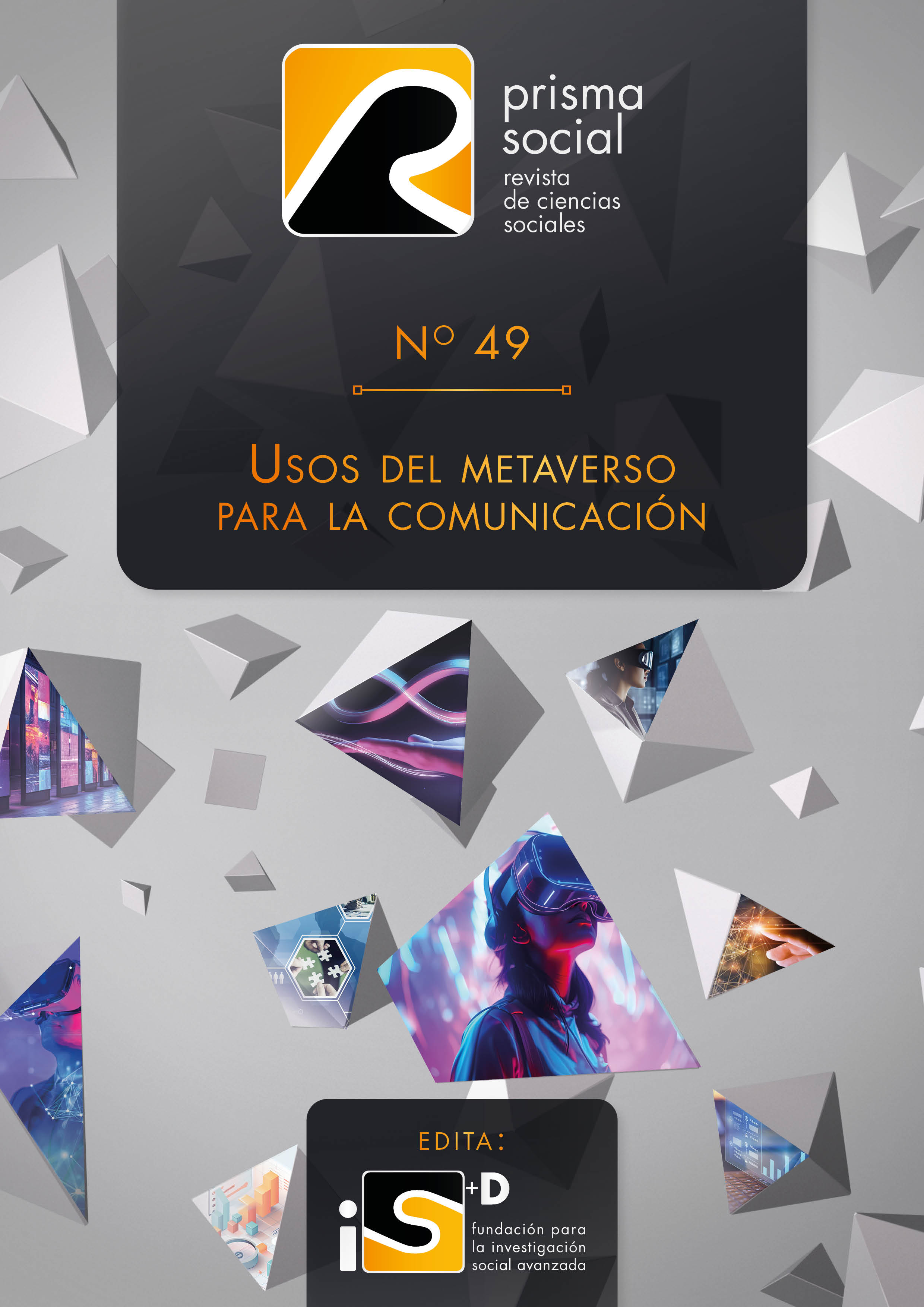
Uses of the Metaverse for Communication
Keywords:
Metaverse, Immersive communication, Journalism, Blockchain, Avatars, Advanced technologyAbstract
The metaverse represents a reality beyond our current understanding, with expectations for it to evolve into a fully immersive 3D virtual ecosystem. While research has explored its applications in tourism, art, education, and gaming, its potential for communication remains a key area of interest. Blockchain technology enables the decentralization of the metaverse, allowing users to securely manage their data and content. With the disappearance of screen limitations, media organizations can provide immersive experiences where audiences become avatars, opening new opportunities for journalism and communication. As digitalization in media continues, the metaverse could become an alternative platform for journalism, similar to how social media became a source for news. Although the metaverse is still in its early stages, its possibilities for journalism are vast, with potential in information production, gamification, storytelling, source management, immersive journalism, and advanced technology. Media organizations cannot ignore its growth, particularly in marketing and asset tokenization. The inclusion of the metaverse in journalism requires new professional roles and the development of ethical guidelines for this emerging field, alongside the adaptation of self-regulation practices. This special issue compiles seven research papers examining the intersection of communication and the metaverse. Topics include immersive journalism, the impact of avatars, new identities in hybrid environments, the use of the metaverse for learning, open-source training for communication professionals, gender dynamics in metaverse discourse, and advertising strategies for digital spaces. Additionally, five research articles from various fields are included in the open section.
Downloads
References
Chen, Z. (2022). Exploring the application scenarios and issues facing Metaverse technology in education. Interactive Learning Environments, online first. https://doi.org//10.1080/10494820.2022.2133148
Chia, A. (2022). The metaverse, but not the way you think: game engines and automation beyond game development. Critical Studies in Media Communication, 39(3), 191-200. https://doi.org/10.1080/15295036.2022.2080850
Godart, E. (2020). Le sujet du virtuel: transformation. Métamorphose des subjectivités. Hermann.
Gursoy, D., Malodia, S. & Dhir, A. (2022). The metaverse in the hospitality and tourism industry: An overview of current trends and future research directions. Journal of Hospitality Marketing & Management, 31(5), 527-534. https://doi.org//10.1080/19368623.2022.2072504
Lee, H.-K., Park, S. & Lee, Y. (2022). A proposal of virtual museum metaverse content for the MZ generation. Digital Creativity, 33(2), 79-95. https://doi.org//10.1080/14626268.2022.2063903
Martín Ramallal, P., & Cárdenas-Rica, M. L. (2022). Metaversos como ciberfuente para el periodismo político. Revista Prisma Social, (39), 95–123. Recuperado a partir de https://revistaprismasocial.es/article/view/4817
Rivas-de-Roca, R. (2022). El periodismo ante la transformación tecnológica. Revista ICONO 14. Revista Científica De Comunicación Y Tecnologías Emergentes, 20(1). https://doi.org/10.7195/ri14.v20i1.1835
Sánchez, H. M. y Canavilhas, J. (2022). Tendencias en la digitalización del periodismo. Anàlisi: Quaderns de Comunicació i Cultura, 66, 3-8. https://doi.org/10.5565/rev/analisi.3549
Downloads
Published
How to Cite
Issue
Section
License
Copyright (c) 2025 Revista Prisma Social

This work is licensed under a Creative Commons Attribution-NonCommercial-NoDerivatives 4.0 International License.
Those authors who publish in this journal accept the following terms:
-
Authors retain copyright.
-
Authors transfer to the journal the right of first publication. The journal also owns the publishing rights.
-
All published contents are governed by an Attribution-NoDerivatives 4.0 International License.
Access the informative version and legal text of the license. By virtue of this, third parties are allowed to use what is published as long as they mention the authorship of the work and the first publication in this journal. If you transform the material, you may not distribute the modified work. -
Authors may make other independent and additional contractual arrangements for non-exclusive distribution of the version of the article published in this journal (e.g., inclusion in an institutional repository or publication in a book) as long as they clearly indicate that the work was first published in this journal.
- Authors are allowed and recommended to publish their work on the Internet (for example on institutional and personal websites), following the publication of, and referencing the journal, as this could lead to constructive exchanges and a more extensive and quick circulation of published works (see The Effect of Open Access).