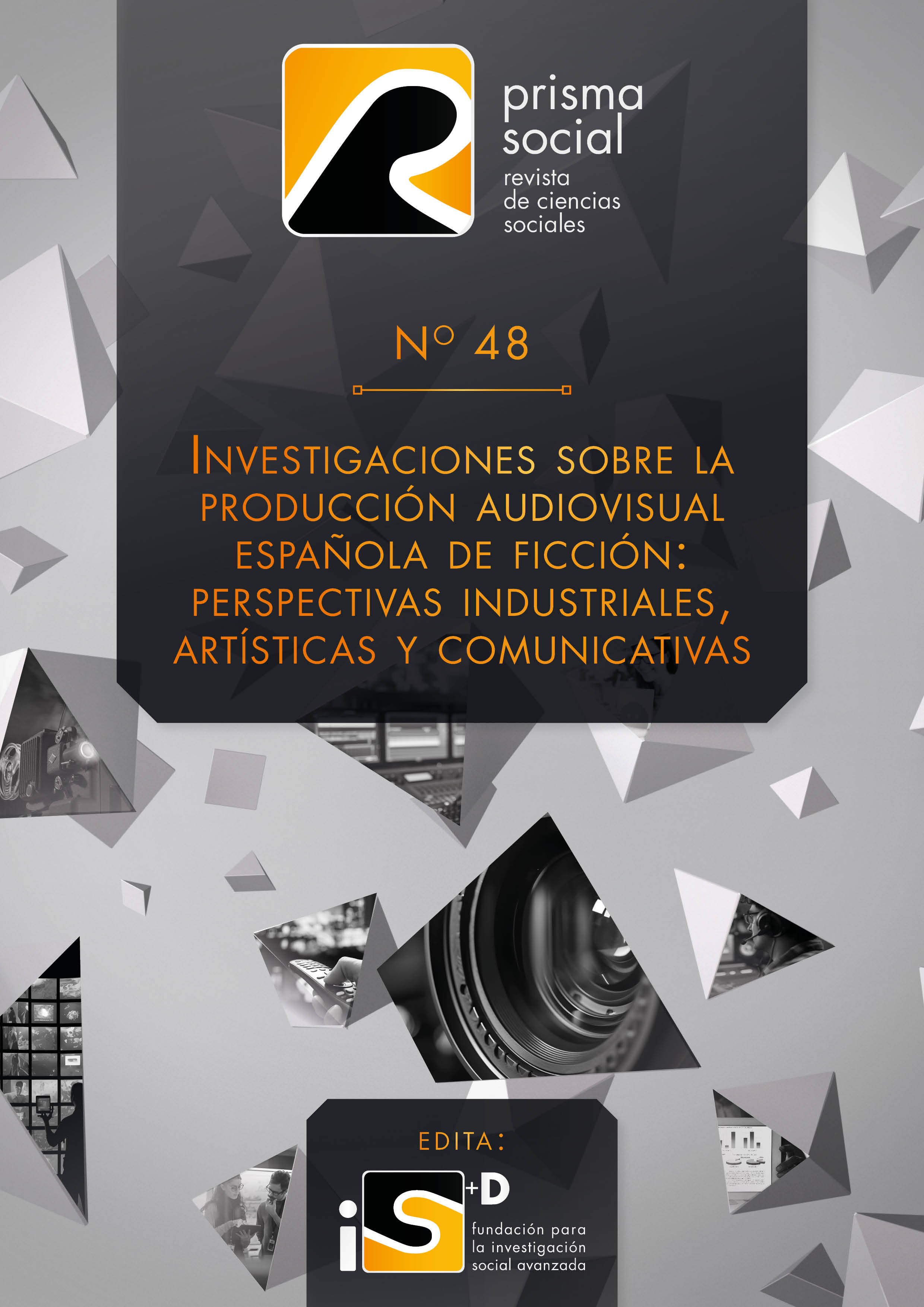
Research on Spanish Fictional Audiovisual Production
Industrial, Artistic, and Communicative Perspectives
Keywords:
producción audiovisual, cine español, plataformas de streaming, transformación digital, industria del entretenimiento, innovación tecnológicaAbstract
The FlixOlé-URJC Chair of Spanish Cinema coordinates this issue of the Prisma Social Journal, focusing on research into Spanish fiction production in film and television. The Spanish audiovisual industry is undergoing a transformation driven by digitalization, the rise of streaming platforms, evolving business models, and changing consumer habits.
Production growth has been remarkable in recent years: production companies increased from 381 in 2019 to 553 in 2023 (+45.14%), and feature films from 670 to 931 (+38.95%), despite the impact of the pandemic. Distribution and exhibition have also changed, with a slight rise in distributors (+13.65%) and a minimal decline in theaters (-2.35%), though box office revenues dropped by 10.84%.
Fiction series have shown signs of stabilization, with 53 productions in 2023. Spain, alongside the UK, leads content production for streaming platforms in Europe, being Netflix’s top EU supplier with 21 original productions in 2023. Additionally, employment in the audiovisual sector has grown by over 93% in three years, mainly due to international film shoots.
Three key factors explain this growth: technological advancements and the consolidation of streaming, Spain’s attractiveness for international productions due to diverse locations and tax incentives, and the high-level training of industry professionals. However, challenges persist, including potential overproduction, global competition, declining theater attendance, job precariousness, and the rise of artificial intelligence.
This monographic issue compiles research addressing fiction production from a multidisciplinary perspective, exploring technological innovations, narrative trends, sustainability, market dynamics, and regulation. It provides a comprehensive view of the industry and its future challenges.
Downloads
References
Álvarez-Monzoncillo, J. M. (2024). La competitividad del ecosistema audiovisual español. McGraw Hill.
Baraybar-Fernández, A., Arrufat-Martín, S., & Díaz-Díaz, B. (2025). The AI Revolution. How Technological Developments Affect the Audiovisual Sector. Springer.
GECA (2024). El ecosistema de la producción en ficción. https://webgeca.geca.es/informes-geca/
ICAA (2023). Estadística de Cinematografía: Producción, Exhibición, Distribución y Fomento. https://estadisticas.cultura.gob.es/CulturaDynPx/culturabase/index.htm?type=pcaxis&path=/t20/p20/a2005/&file=pcaxis
Ministerio para la Transformación Digital y de la Función Pública (MTDFP) (2023). Informe del Sector Audiovisual. https://digital.gob.es/dam/es/portalmtdfp/comunicacion/notas-de-prensa/comunicacion_SETID/202406014_NdP_Informe_Audiovisual.pdf
Rajas, M. & Paz Gil, I. (2023). Consumo de cine español en plataformas de streaming. En J. Sierra Sánchez y J. Medina Contreras, Encrucijada del audiovisual en la era de lo virtual. McGraw-Hill, pp. 355-368.
Schneeberger, A. & Fontaine, G. (2022). Audiovisual fiction production in Europe 2022 - Figures. European Audiovisual Observatory. https://www.oficinamediaespana.eu/noticias/item/4082-observatorio-europeo-del-audiovisual-nuevo-informe-sobre-produccion-audiovisual-de-ficcion-en-europa
Servicio Público de Empleo Estatal (SEPE) (2024). El mercado de trabajo del sector audiovisual en España. https://www.sepe.es/HomeSepe/es/que-es-el-sepe/comunicacion-institucional/noticias/detalle-noticia?folder=/SEPE/2025/Enero/&detail=crecimiento-del-sector-audiovisual-en-espana
Spain Hub Audiovisual (2024). Informe 2024. https://spainaudiovisualhub.mineco.gob.es/es/actualidad/2--informe-sobre-el-sector-audiovisual-2023-de-spain-audiovisual
Downloads
Published
How to Cite
Issue
Section
License
Copyright (c) 2025 Revista Prisma Social

This work is licensed under a Creative Commons Attribution-NonCommercial-NoDerivatives 4.0 International License.
Those authors who publish in this journal accept the following terms:
-
Authors retain copyright.
-
Authors transfer to the journal the right of first publication. The journal also owns the publishing rights.
-
All published contents are governed by an Attribution-NoDerivatives 4.0 International License.
Access the informative version and legal text of the license. By virtue of this, third parties are allowed to use what is published as long as they mention the authorship of the work and the first publication in this journal. If you transform the material, you may not distribute the modified work. -
Authors may make other independent and additional contractual arrangements for non-exclusive distribution of the version of the article published in this journal (e.g., inclusion in an institutional repository or publication in a book) as long as they clearly indicate that the work was first published in this journal.
- Authors are allowed and recommended to publish their work on the Internet (for example on institutional and personal websites), following the publication of, and referencing the journal, as this could lead to constructive exchanges and a more extensive and quick circulation of published works (see The Effect of Open Access).