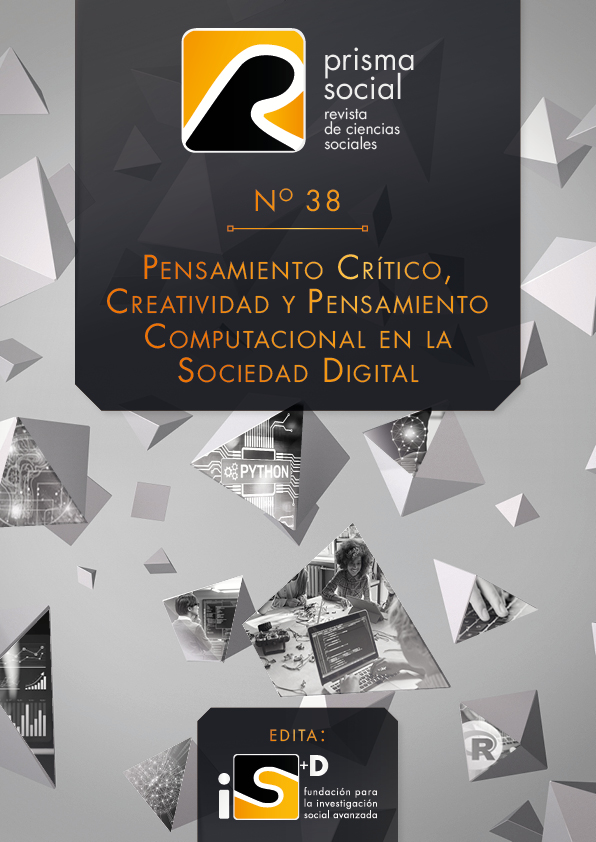
Critical Thinking, Creativity and Computational Thinking in the Digital Society
Keywords:
pensamiento crítica, pensamiento computacional, educación, sociedad digitalAbstract
Vivimos en una sociedad cada vez más exigente, ya sea por las actuales circunstancias globales o por los retos profesionales que se nos plantean a diario. Por ello, somos conscientes de que, para satisfacer las demandas de una sociedad en constante transformación y adaptación, es necesario que los currículos incluyan estas nuevas dimensiones de la formación (CSTA, 2016). Hay aprendizajes que requieren creatividad, pensamiento crítico y, cada vez más, pensamiento computacional (Bers, 2022); (Bers, 2017); (Resnick, 2017); (Monteiro, Miranda-Pinto, & Osório, 2021). Hoy en día, la programación se considera una nueva alfabetización, fundamental para satisfacer las demandas de una sociedad cada vez más digital, en constante cambio y adaptación. La programación circunda el desarrollo de habilidades asociadas al pensamiento computacional, como la resolución de problemas o el razonamiento lógico. Desde esta perspectiva, aprender a programar incluye habilidades transversales, con el interés de formar ciudadanos activos, con espíritu crítico, creativo y autonomía.
Downloads
References
Bers, M.U. (2017). Coding as a Playground: Programming and Computational Thinking in the Early Childhood Classroom (1st ed.). Routledge. https://doi.org/10.4324/9781315398945
Bers, M. U. (2022). Beyond Coding - How Children Learn Human Values Through Programming. The MIT Press.
CSTA. (2016). K-12 Computer Science Framework, 297. Obtido de https://dl.acm.org/citation.cfm?id=3079760
Miranda Pinto, M. S. (2019). Programación y robótica en educación infantil: Estudio multi caso en Portugal. Prisma Social, (25), 248–276. Obtido de https://revistaprismasocial.es/article/view/2733
Miranda Pinto, M. S., & Osório, A. (2019). Aprender a programar en Educación Infantil: análisis con la escala de participación. Pixel-Bit, Revista de Medios y Educación, (55), 133–156. https://doi.org/10.12795/pixelbit.2019.i55.08
Monteiro, A. F., Miranda-Pinto, M., & Osório, A. J. (2021). Coding as Literacy in Preschool: A Case Study. Education Sciences, 11(5), 198. https://doi.org/https://doi.org/10.3390/educsci11050198
Resnick, M. (2017). Lifelong Kindergarten - Cultiving Creativity through Projects, Passion, Peers, and Play. MIT Press.
Strawhacker, A., & Bers, M. U. (2018). What they learn when they learn coding: investigating cognitive domains and computer programming knowledge in young children. Educational Technology Research and Development, 67(3), 541–575. https://doi.org/10.1007/s11423-018-9622-x
Sullivan, A., & Bers, M. U. (2016). Robotics in the early childhood classroom: learning outcomes from an 8-week robotics curriculum in pre-kindergarten through second grade. International Journal of Technology and Design Education, 26(1), 3–20. https://doi.org/10.1007/s10798-015-9304-5
Downloads
Published
How to Cite
Issue
Section
License
Copyright (c) 2022 Revista Prisma Social

This work is licensed under a Creative Commons Attribution-NonCommercial-NoDerivatives 4.0 International License.
Those authors who publish in this journal accept the following terms:
-
Authors retain copyright.
-
Authors transfer to the journal the right of first publication. The journal also owns the publishing rights.
-
All published contents are governed by an Attribution-NoDerivatives 4.0 International License.
Access the informative version and legal text of the license. By virtue of this, third parties are allowed to use what is published as long as they mention the authorship of the work and the first publication in this journal. If you transform the material, you may not distribute the modified work. -
Authors may make other independent and additional contractual arrangements for non-exclusive distribution of the version of the article published in this journal (e.g., inclusion in an institutional repository or publication in a book) as long as they clearly indicate that the work was first published in this journal.
- Authors are allowed and recommended to publish their work on the Internet (for example on institutional and personal websites), following the publication of, and referencing the journal, as this could lead to constructive exchanges and a more extensive and quick circulation of published works (see The Effect of Open Access).